

CNSA New Board Structure
The Canadian Nursing Students’ Association (CNSA) is governed by a national Board of Directors designed to ensure transparent, accountable, and student-led decision-making.
As of January 1, 2026, CNSA has adopted a newly restructured Board of Directors to better reflect student priorities, strengthen oversight, and support long-term organizational sustainability. This page outlines the governance structure, decision-making processes, and leadership pathways available to nursing students across Canada.
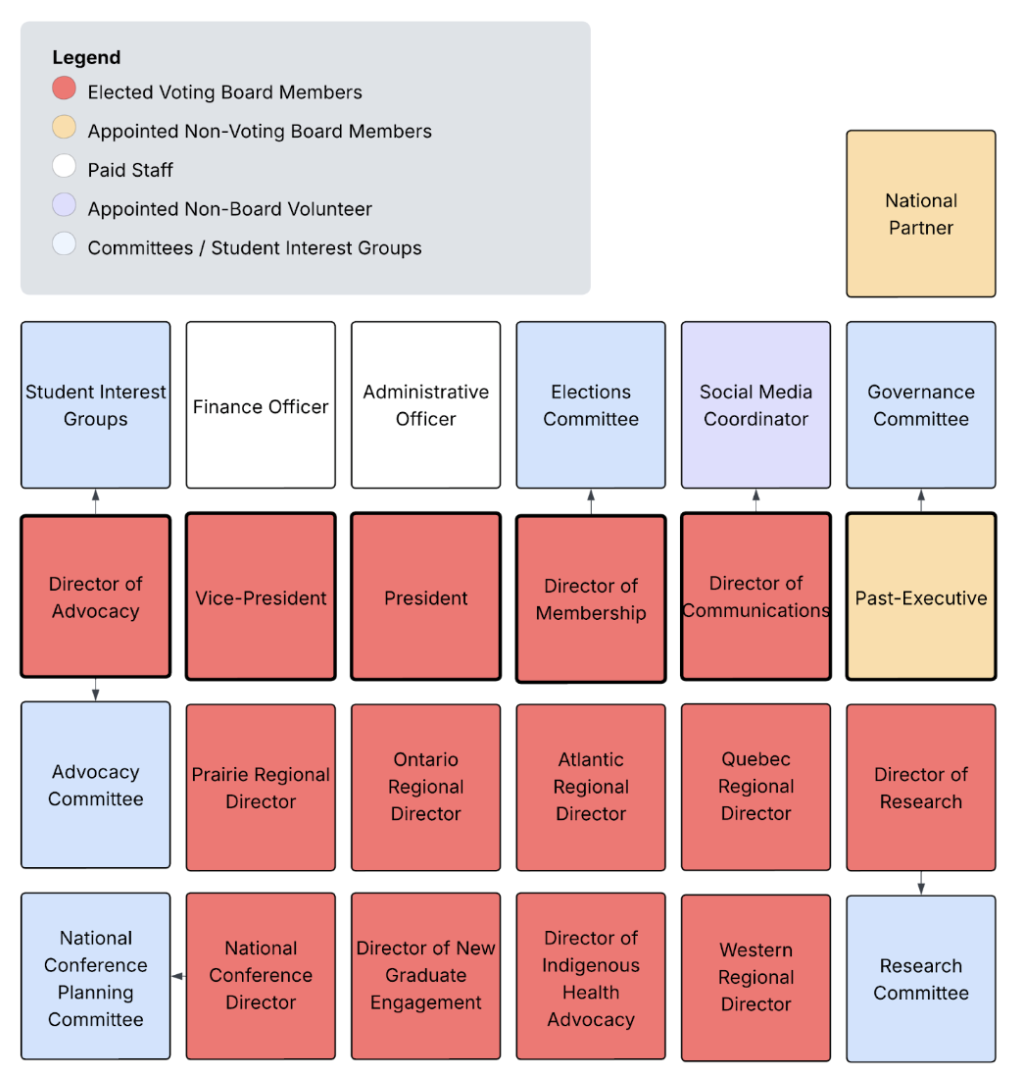
Governance Transition Timeline
January 1, 2026 – New Board structure formally adopted
January 5 to January 31, 2026 – Elections and applications conducted under the new structure
March 1, 2026 – Newly elected and appointed Board members assume office
Until March 1, 2026, the outgoing Board remains responsible for operations to ensure continuity and stability.
Executive Committee
The Executive Committee (EC) is responsible for the day-to-day leadership, coordination, and strategic oversight of the Canadian Nursing Students’ Association (CNSA). Members of the Executive Committee are elected voting members of the Board of Directors and hold additional governance responsibilities.
Members of the Executive Committee
President
Vice-President
Director of Advocacy
Director of Membership
Director of Communications
The Executive Committee works collaboratively to:
Set organizational priorities and strategic direction
Oversee national operations and governance
Support and coordinate the work of Regional Directors, committees, and portfolios
Ensure accountability to CNSA bylaws, policies, and the National Assembly
-
President(Elected | Voting)
Provides overall leadership, strategic direction, and governance oversight for the Association. Serves as CNSA’s chief spokesperson and represents nursing students at national and international levels.
Key Responsibilities
Chairs the Board of Directors, Executive Committee, and General Membership meetings
Oversees implementation of the CNSA Strategic Plan
Ensures compliance with bylaws, policies, and federal not-for-profit legislation
Builds partnerships, sponsorships, and national collaborations
Mentors and supports Board members in fulfilling their mandates
—————
Vice-President(Elected | Voting)
Supports the President and ensures continuity of governance and operations. Assumes presidential duties when required.
Key Responsibilities
Oversees Board operations and governance best practices
Supports implementation of the Strategic Plan
Represents CNSA in national academic and professional forums
Serves as CNSA’s representative to CASN
Coordinates national initiatives and supports Board collaboration
—————
Director of Advocacy(Elected | Voting)
Leads CNSA’s advocacy, policy development, and government relations, while advancing equity, inclusion, and student voice.
Key Responsibilities
Develops and implements national advocacy strategies
Represents nursing students in policy and stakeholder consultations
Coordinates federal advocacy initiatives (e.g., Day on the Hill)
Leads diversity, equity, inclusion, and accessibility (DEIA) initiatives
Oversees and mentors Student Interest Groups (SIGs)
—————
Director of Membership(Elected | Voting)
Oversees membership services, chapter engagement, elections, and national membership initiatives.
Key Responsibilities
Manages membership recruitment, retention, and renewal campaigns
Chairs the Elections Committee
Oversees national elections and appointments
Coordinates National Nursing Students’ Week
Supports Regional Directors and chapter leadership
—————
Director of Communications(Elected | Voting)
Leads CNSA’s external communications, media relations, and public engagement, amplifying the national voice of nursing students.
Key Responsibilities
Represents nursing students on the Canadian Nurses Association (CNA) Board
Oversees media relations, public statements, and digital communications
Manages CNSA’s social media platforms
Designs national advocacy and awareness campaigns
Ensures consistent, professional public messaging
Board of Directors (Non-Executive Voting Members)
In addition to the Executive Committee, the Board of Directors includes elected voting members who represent regions and key national portfolios:
Regional Directors
Atlantic
Québec
Ontario
Prairies
Western
Director of Indigenous Health and Advocacy
Director of Research
Director of New Graduate Engagement
National Conference Director
These members participate fully in Board decision-making and voting, while focusing on portfolio-specific leadership and regional representation.
-
Regional Directors(Elected | Voting)
(Atlantic, Québec, Ontario, Prairies, Western)
Serve as the primary liaison between CNSA and chapter schools within their region.Key Responsibilities
Represent regional student concerns at the national level
Support chapter engagement, recruitment, and governance
Host regional meetings and orientations
Maintain communication with Official and Associate Delegates
Build relationships with regional nursing organizations
Reports to: President & Board of Directors
Term: One year -
Director of Indigenous Health and Advocacy(Elected | Voting)
Advances Indigenous health, reconciliation, and representation within CNSA, centering Indigenous perspectives and cultural safety.
Key Responsibilities
Leads Indigenous health advocacy initiatives
Builds partnerships with Indigenous nursing organizations and communities
Coordinates national Indigenous awareness events and observances
Advises the Board on Indigenous health and governance matters
Supports culturally safe programming and conference inclusion
Reports to: President & Board of Directors
—————
Director of Research(Elected | Voting)
Promotes nursing student research, scholarship, and evidence-informed practice across Canada.
Key Responsibilities
Develops and oversees CNSA’s student research strategy
Mentors students engaging in research and scholarly dissemination
Builds academic and professional research partnerships
Integrates research programming into the National Conference
Promotes visibility of student-led research
Reports to: President & Board of Directors
—————
Director of New Graduate Engagement(Elected | Voting)
Supports nursing students transitioning into professional practice and sustained engagement post-graduation.
Key Responsibilities
Develops transition-to-practice resources
Maintains NCLEX preparation supports
Builds partnerships supporting new graduates
Promotes ongoing CNSA engagement beyond graduation
Reports to: President & Board of Directors
-
(Elected | Voting — Host Institution–Based)
Role Overview
The National Conference Director leads the planning and execution of the CNSA National Conference. This position is held by a representative of the institution elected by members to host the National Conference.
Members vote to select the host institution, not an individual candidate. Once selected, the host institution appoints its National Conference Director and establishes the National Conference Planning Committee in accordance with CNSA policies.
Key Responsibilities
Chair the National Conference Planning Committee
Oversee conference logistics, budgeting, and programming
Coordinate sponsorship and stakeholder engagement
Report conference outcomes and financial audits
Reports to: Board of Directors
Note: The National Conference Director and Conference Planning Committee are designated by the elected host institution. Only representatives of the host institution may hold these roles.
Q: Are members voting for a person or a school?
A: Members vote to elect the host institution. The institution then appoints its conference leadership team.
Appointed Non-Voting Members, Staff, and Volunteer Support
In addition to elected voting members of the Board of Directors, the Canadian Nursing Students’ Association (CNSA) is supported by appointed non-voting members, staff, and non-board volunteers who provide continuity, operational expertise, and advisory support.
These roles do not hold voting authority and are not responsible for governance decisions. Instead, they support the work of the Board by contributing institutional knowledge, administrative and financial oversight, communications support, and external partnership engagement. This structure ensures that CNSA remains student-led, while benefiting from professional support and national collaboration.
-
Past-Executive(Appointed by outgoing board of Directors | Non-Voting)
Provides continuity, institutional memory, and advisory support to the incoming Board.
Key Responsibilities
A past member of executive committee
Supports leadership transition
Advises Executive Committee when requested
Ensures knowledge transfer between governance years
—————
National Partner (Rotating External Partner Seat | Non-Voting))
The National Partner is a rotating external partner seat that supports collaboration between CNSA and key national nursing organizations. This seat changes from year to year and may be held by a partner organization such as CNA, CFNU, or CASN, depending on CNSA’s priorities, initiatives, and partnership agreements.
Purpose of the National Partner seat
Strengthen national collaboration and relationship-building
Support alignment on shared priorities (student leadership, advocacy, workforce, education)
Provide a formal point of connection between CNSA and national nursing stakeholders
Facilitate knowledge exchange and opportunities for nursing students (events, resources, engagement)
Status and Participation
Not an elected student position
Non-voting (advisory/partner role)
Participates in meetings or initiatives as invited and as appropriate to the partnership
-
These positions support the work of the Board of Directors and help ensure CNSA operates smoothly, consistently, and in compliance with organizational policies. Staff roles do not vote on Board decisions.
Finance Officer (Staff | Non-Voting)
The Finance Officer supports the Association’s financial operations and accountability processes. This includes supporting budgeting, financial tracking, and financial reporting required for Board oversight and organizational compliance.
Primary function: Financial administration and support to the Board
Works with: President, Executive Committee, Board (as needed)—————
Administrative Officer (Staff | Non-Voting)The Administrative Officer supports CNSA’s day-to-day administration and operational continuity. This role helps coordinate internal processes, documentation, and organizational logistics that enable the Board and committees to function effectively.
Primary function: Organizational administration and operational support
Works with: Executive Committee, Director of Membership (elections/administration support as needed), Board (as needed) -
These roles support CNSA operations and communications but are not members of the Board of Directors and do not vote.
Social Media Coordinator (Appointed Volunteer | Non-Board | Non-Voting)
The Social Media Coordinator supports CNSA’s digital presence by assisting with content scheduling, post coordination, and day-to-day platform support under the direction of the Director of Communications.
Primary function: Communications support (content coordination + scheduling)
Reports to / supported by: Director of Communications
Works with: Board portfolios and