
Director of Advocacy Candidates

Rhoda Ghebregziabiher
University of Albert
-
Hi, my name is Rhoda, and I’m a third-year nursing student. I’m Eritrean and the first in my family to attend university, which gives me a personal understanding of how identity, culture, community, and lived experience shape healthcare. My leadership approach is collaborative and values-driven, focused on uplifting others and creating safe spaces. For me, effective leadership also means being attentive to gaps or unmet needs within a group and seeking perspectives of those most impacted before taking action. Having grown up in predominantly white spaces, I know what it feels like to be unseen or underrepresented, and that experience fuels my drive to lead with empathy and amplify others’ voices. My volunteer work with NotJustYou, a non-profit sickle cell support organization, and the Africa Centre has been foundational in shaping my commitment to equity, inclusion, and community advocacy. Through these roles, I engaged with diverse communities, supported individuals facing systemic barriers, and contributed to initiatives that promote access to resources. These experiences have strengthened my understanding of structural inequities in healthcare and education, preparing me to meaningfully advocate and lead DEIA initiatives within CNSA and support students in developing inclusive SIGs. My clinical and work experience as an HCA has strengthened my ability to communicate and collaborate within interprofessional teams to advocate for patients with diverse needs. Working under the supervision of Dr. Carole Estabrooks at the UofA further honed my critical thinking and policy perspective, helping me balance research and clinical practice while learning to evaluate evidence to guide impactful decisions. These experiences strengthened my skills and clarified how meaningful policy and advocacy make a real difference. Nursing extends beyond the bedside and I want to help build a supportive nursing community that empowers students and fosters collaboration that impacts both our peers and the communities we serve.
-
When deciding which issues warrant national advocacy, I would start by assessing the impact and urgency to identify how it aligns with CNSA’s mission and priorities. I would prioritize issues that directly impact nursing students’ education, professional growth, mental health, or ability to provide safe and equitable care. Gathering information from students includes surveys, questionnaires, focus groups, and chapter consultations, with particular attention to voices that are often underrepresented or marginalized. At the same time, it is important to use strong research, policy data, relevant statistics, and regulatory insights to guide decisions. Transparent communication about the decision making process and supporting evidence is also essential in justifying these choices to members who disagree. I would emphasize that CNSA cannot address every issue simultaneously, but by focusing on high-impact, strategically aligned initiatives, we can create significant impact. I would also provide opportunities for members to engage in advocacy at local or chapter levels for issues that may not be taken on nationally, ensuring that all voices are heard and valued, even if the organization’s focus must be selective.
-
To ensure CNSA’s advocacy is evidence-informed, I would base decisions on research, policy data, and best practices, drawing from academic literature, regulatory guidance, and real-world insights from community experiences. This ensures that our decisions are credible, actionable, grounded in facts, and meaningful in practice. I would prioritize fairness and transparency by clearly communicating how advocacy priorities are chosen, setting measurable goals, and actively seeking student perspective to ensure decisions are equitable. I see representing diverse student perspectives as intentionally listening to students whose voices are often quiet or overlooked, learning from their lived experiences, and creating opportunities for them to shape advocacy in ways that truly reflect their needs. When opinions conflict, I would facilitate open, respectful dialogue, identify areas of common ground, and clearly explain all the different factors that shaped the final approach.
-
I would support chapters and individual students in developing advocacy skills by creating accessible mentorship-based learning opportunities, including workshops, position statement trainings, and biweekly office hours where students can seek guidance in a supportive, low-pressure space. I would work closely with Regional Directors to help chapters translate local priorities into meaningful advocacy initiatives and create ways for students to engage in national opportunities such as “Day on the Hill,” consultations, and working groups. I bring a deeply relational approach shaped by my own experience growing up as a quiet person. I understand how external pressures can make it difficult to speak up, and over time I have developed a strong commitment to using my voice to stand up for others. Because of this, I would focus on providing strong resources for building students’ advocacy skills and their confidence, so they feel empowered to speak up and lead meaningfully in policy work at both local and national levels.
-
As a Black woman in nursing, I have personally witnessed how issues of race, power, privilege, and access shape both healthcare and educational spaces in profound ways. These experiences have shown me that inequities are lived realities that directly affect students, patients, and communities. Because of this, my commitment to DEIA in advocacy comes from a deeply personal place. I carry these experiences with me into my leadership, always being mindful of whose voices are centered, whose are missing, and how I can help create space for students who may feel overlooked or marginalized. I would promote DEIA through advocacy initiatives by ensuring that equity is treated as a central lens in all CNSA advocacy work. This means actively considering who is truly affected by policies, whose voices are too often left out of the room, how decisions might unintentionally create new barriers, and how advocacy can be used to open doors rather than close them. In practice, this would look like regularly listening to students from different backgrounds, building relationships with community and advocacy organizations, and making sure CNSA’s policy positions are grounded in what students are actually experiencing as they navigate systemic inequities. In SIGs, I would take a mentorship-based approach that is supportive, accountable, and deeply relational, focused on helping students feel seen and heard in their leadership. I would be particularly attentive to students who may feel hesitant to take up space, whether because of race, culture, language, or past experiences of exclusion, and intentionally create room for them to lead in ways that feel best for them. This includes supporting SIGs in designing events that are financially, geographically, and culturally accessible, while also encouraging collaboration.
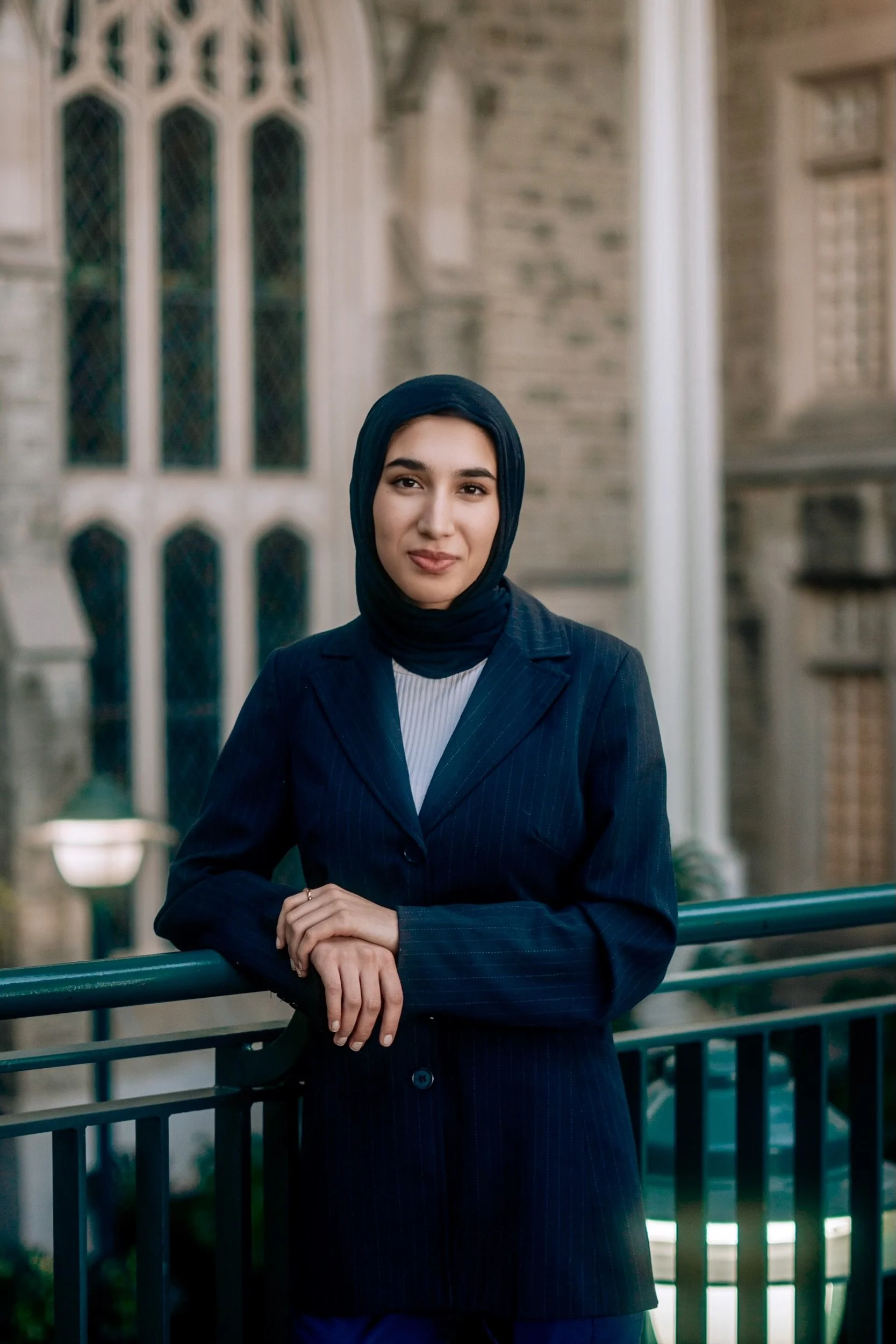
Zahra Nadeem
Western University
-
Change, to me, is growth in motion, a willingness to fall forward, revise, and try again with more clarity than before. Meaningful change rarely happens alone, and this principle has guided both my leadership approach and my commitment to advocacy.
From a young age, I have been fascinated by policy and governance. In high school, after a research project on immigrant youth experiences was recognized by the Science department at Western University, we contributed policy recommendations to the provincial government based on the findings. That experience showed me how individuals' lived experience, when translated into policy, can shape systems and improve outcomes over time. Since then, I have remained actively engaged in advocacy through local and provincial election work and, most significantly, through student governance.
Over the past three years, I have served as a Vice President of Nursing, Councillor and At-Large Senator representing over 40,000 undergraduate students. In these roles, I supported advising on institutional budgeting and resource allocation by translating student-wide consultation into recommendations for teaching quality, advising capacity, and experiential learning funding priorities; supporting the development of a nursing clinical placement travel bursary; supported governance and hiring decisions across more than fifteen committee appointments; and maintained ongoing advocacy with senior administration at Western. My most formative governance experience was co-organizing a Senate motion to incorporate human rights principles into institutional investment policy, including divestment from weapons manufacturers. This work garnered support from over seventy campus-wide clubs, all seven faculty councils, professors and deans from every faculty, and all core unions, and mobilized more than four hundred student emails, reinforcing my belief in the power of coalition-building and structured advocacy.
Beyond institutional governance, I served as an expert panel reviewer for the Registered Nurses’ Association of Ontario’s Best Practice Guideline on Alternative Approaches to the Use of Restraints, contributing to standards that guide nursing education and clinical care across the province. -
There are many issues affecting nursing students, and a national organization cannot advocate for everything simultaneously. Determining which issues warrant national advocacy requires structured student consultation, rigorous research, and a clear understanding of where national coordination adds the most value.
Through my roles in student governance, I have worked closely with nursing students and student leaders to identify concerns that are not only widespread, but systemically rooted and directly tied to workforce sustainability and patient care. National survey data on Canadian nursing students consistently identifies financial strain during unpaid clinical placements as a top concern, with compensation for placement hours emerging as a high-consensus priority. This aligns with policy positions advanced by the Canadian Federation of Nurses Unions and demonstrates where national advocacy can be both justified and impactful.
My background in research further informs how I would prioritize issues. Having conducted qualitative research projects and systematic reviews, I have learned the importance of transparent, ethical, and methodical processes when translating concerns into advocacy priorities. Evidence is essential not only to identify issues, but to justify why certain concerns require collective, national action rather than localized responses.
As a national advocacy leader, I would work collaboratively with provincial representatives to synthesize regional priorities into a coherent national strategy, recognizing differences across jurisdictions while maintaining a focused advocacy agenda. I have learned that advancing one or two achievable priorities is often more effective than dispersing efforts across many competing demands.
Disagreement is an expected part of national advocacy within a diverse membership. In those moments, my focus is on grounding decisions in evidence, feasibility, and CNSA’s national mandate, ensuring advocacy remains focused, credible, and effective even when perspectives differ. -
Conflicting perspectives among nursing students are both expected and valuable, as they often highlight gaps that consensus can obscure. To ensure CNSA’s advocacy remains evidence-informed, ethically grounded, and representative, I would rely on three deliberate practices.
First, I would anchor advocacy priorities in structured data rather than volume of opinion. This includes national and jurisdiction-specific survey data, consultation summaries, and external evidence from nursing and health policy bodies.
Second, I would apply an equity-informed lens to decision-making by examining who is most impacted by an issue and whose voices may be underrepresented in consultation processes. Rather than defaulting to majority viewpoints, I focus on identifying overlapping priorities across diverse experiences, ensuring advocacy reflects both prevalence and impact.
Finally, when conflict arises, I would work with provincial directors to synthesize perspectives into a clear, time-bound advocacy position aligned with CNSA’s national mandate. Clear criteria, defined objectives, and accountability prevent advocacy from becoming reactive or fragmented. -
I would support chapters and individual students by focusing on skill-building that is practical. This year, I mentored and trained over a dozen students interested in governance, supporting pathways into nursing leadership, council, and advocacy roles. Through that work, I learned that advocacy skills develop most effectively when students are given clear tools, structure, and confidence in their ability to influence systems.
First, I would support chapters through targeted training on evidence-based advocacy, including how to interpret policy briefs, synthesize research into clear recommendations, and translate lived experience into credible advocacy positions. I've learned over the years that structured mentorship and active, skills-based training improves engagement and retention more effectively than passive resources or support.
Second, I would help chapters design advocacy projects that are focused and achievable, guiding students to identify one or two priorities supported by data rather than dispersing efforts across many issues. This approach increases follow-through and tangible outcomes.
Finally, I would create opportunities for peer-to-peer mentorship by connecting chapters with experienced student advocates, allowing knowledge transfer across institutions and regions. I've learned that confidence and participation grow when advocacy is modelled and shared, supporting in sustainable engagement. -
I would promote diversity, equity, inclusion, and accessibility by embedding EDIDA directly into how advocacy initiatives and Student Interest Groups are trained and supported. My approach is shaped by my experience as Vice President EDIDA within my nursing student association, where I focused on building practical, systems-level change.
In that role, I led the first every training for nursing council members and coordinators through EDIDA and gender-based sexual violence training, equipping student leaders with applied skills for navigating bias, discrimination, and nursing specific leadership and clinical situations. I also led equity-focused advocacy initiatives, including escalating concerns that clinical placement students lacked clear and safe pathways to report discrimination by preceptors and patients, which prompted leadership review of reporting processes.
At the national level, I would carry this approach forward by supporting structured, active skills-based training for Student Interest Group leads and advocacy teams, ensuring EDIDA principles are actively applied in consultation and decision-making rather than treated as abstract concepts. I would also encourage groups to define clear equity impacts and engage with community partners, drawing on my experience building collaborations that expanded access to non-traditional experiential learning and supported engagement with marginalized populations.
Through intentional training, accountability, and collaboration, I would work to ensure EDIDA remains a foundational component of CNSA’s advocacy work.